What is Artificial Intelligence? Explained with Real Business Examples.
AI teaches computers to think and learn like humans, transforming business operations through practical automation and predictive insights.

TL;DR
Artificial Intelligence (AI) isn't just about robots or ChatGPT — it's the science of teaching computers to think, learn, and make decisions like humans. From predicting customer needs to automating invoices, AI transforms operations into measurable opportunities. This article breaks down what AI really is, how it works in business contexts, and shows five practical examples — from HR screening to predictive maintenance — that are already reshaping efficiency, accuracy, and growth.
Introduction
If you've ever chatted with a support bot, received a Netflix recommendation, or seen ChatGPT write an email draft, you've witnessed AI in action. However, when business leaders hear "artificial intelligence," they often imagine futuristic machines instead of real, tangible tools improving daily work. The truth is simpler: AI already drives cost savings, better customer service, and faster decision-making across industries. Whether you run a logistics firm in Dallas or a small agency in Calgary, understanding what AI actually means (beyond the buzzwords) is the first step toward using it strategically.
Why it matters
The biggest misconception about AI is that it's "too technical" or "too early." In reality, AI is now where cloud computing was a decade ago: ubiquitous but unevenly understood. Companies that invest early don't just automate tasks — they unlock competitive advantages:
- Faster decisions — AI analyzes thousands of variables in seconds, identifying trends humans might miss.
- Reduced error — machine learning models detect anomalies in data before they become costly mistakes.
- Customer personalization — recommendation engines and NLP systems tailor offers and support to individual preferences.
- Predictive foresight — forecasting demand, churn, or equipment failures helps leaders act before problems arise.
Research from McKinsey shows that 55% of organizations now use AI in at least one function, with top performers gaining margins 3-5× higher than peers. The gap isn't technological — it's operational.
Understanding what AI is (and isn't) allows executives to move from hype to ROI. Before hiring a data scientist or buying an "AI-powered" tool, leaders need conceptual clarity — the kind that turns curiosity into strategy.
Understanding AI in practice
Core concepts
AI is an umbrella term covering systems that can perceive, reason, learn, and act. At its core:
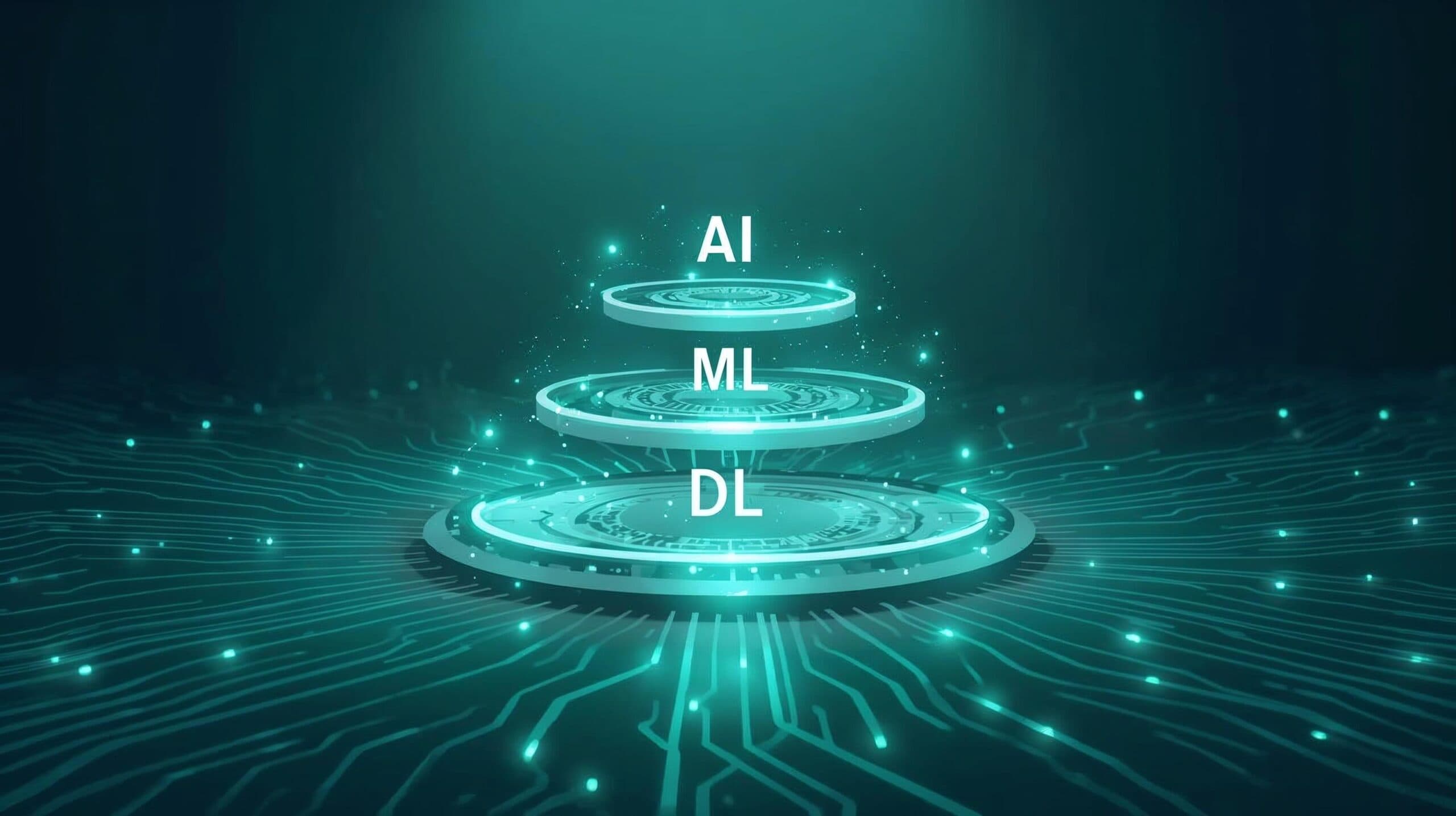
- Artificial Intelligence (AI): the science of making machines smart, mimicking human reasoning.
- Machine Learning (ML): algorithms that learn patterns from data instead of following fixed rules.
- Deep Learning (DL): a subfield of ML using layered neural networks to detect complex relationships (like image recognition or voice transcription).
- Natural Language Processing (NLP): allows machines to understand and generate human language.
Think of AI as the goal, ML as the method, DL as the engine that drives it forward. To complete the picture, add NLP — the bridge between humans and machines.
To make it easier to remember: AI = Goal, ML = Method, DL = Engine, NLP = Voice. It's how machines listen, read, understand, and talk back.
How AI works in business
Every AI system follows a similar pipeline:
- Collect data — from CRM records, IoT sensors, or support tickets, etc.
- Prepare data — clean, label, and structure it for analysis.
- Train model — feed examples to a machine-learning algorithm.
- Validate & deploy — test accuracy, then integrate results into existing systems (e.g., Power Automate, Power BI, or SharePoint).
- Monitor & improve — continuously refine with feedback loops.
Example: a retail company might train a model on past sales to forecast next month's demand. Integration through Power Automate triggers restock workflows when inventory dips below the threshold.
Real-world examples
1. HR & recruitment automation
- AI tools scan resumes, score candidates, and surface best fits based on skills, saving hours of manual review.
- Microsoft's Azure AI Document Intelligence or LinkedIn's Talent Insights plug into SharePoint for automated candidate tracking.
2. Finance & accounting control
- Machine Learning models detect duplicate invoices or flag transactions outside normal patterns.
- Power Automate flows can route suspicious records for manual approval, reducing audit risk by up to 60%.
3. Customer service & chatbots
- Natural Language Processing (NLP) engines like Azure AI Language enable bots that understand context and intent, providing instant support 24/7.
- Integration with Teams or website chat forms creates low-friction customer experiences.
4. Predictive maintenance in operations
- AI models analyze sensor data to predict when equipment will fail before it does.
- Manufacturing and energy firms use Azure Machine Learning and IoT Hub for this, cutting downtime by 20-30%.
5. Marketing & sales enablement
- AI segment builders cluster customers based on behaviour and intent.
- Tools like Dynamics 365 Customer Insights or HubSpot AI recommend the next best action or content for each lead.
Evaluate where AI can add value
Ask:
- Which tasks are repetitive or rule-based?
- Where do we lose time manually analyzing data?
- Could predictive insights improve decision timing?
Prioritize projects that save time or increase accuracy without major risk or regulatory hurdles. Pilot AI in one workflow before scaling. Measure ROI with clear metrics like hours saved, error reduction, or conversion improvement.
Business impact
When applied correctly, AI doesn't replace humans — it amplifies human decision-making. According to PwC, AI could contribute over $15 trillion to the global economy by 2030. SMBs that adopt AI early see:
- 25-40% reduction in manual tasks through workflow automation.
- Up to 50% faster reporting cycles with AI-driven data preparation.
- Improved customer satisfaction scores by 15-25%.
The ROI is clear: AI turns data from a burden into a strategic asset. Companies using AI to predict maintenance failures, improve cashflow forecasting, or personalize marketing messages are seeing payback within months, not years. For leaders, the challenge is no longer "Should we use AI?" but "How fast can we implement it responsibly?"
Conclusion
AI is not the future of business — it's the present tense of innovation. The leaders who learn its language now will shape how their industries operate tomorrow. From data entry to strategy execution, AI is quietly transforming routine work into insight-driven value. Start small, experiment responsibly, and measure what matters. Every automation, every model, every tiny improvement adds up to a competitive edge.
Frequently asked questions
What is artificial intelligence in simple terms?
Artificial intelligence is software that can perform tasks that normally require human intelligence, such as understanding language, recognizing patterns, making predictions, or recommending actions.
How can small businesses use AI?
Small businesses can use AI for lead intake, customer support, reporting, invoice follow-up, scheduling, content drafting, and other recurring workflows that consume owner or staff time.
What is the difference between AI and automation?
Automation follows predefined rules to complete tasks. AI can interpret language, classify information, summarize context, make recommendations, and help automation handle more variable work.